Landlord maintenance reports
Landlord maintenance reports, without the rewriting
Every repair ends with the same job: telling the landlord what happened, what’s being done and what they need to decide. Here’s what a good landlord repair report contains, a checklist you can use today, and how Tenote gives you the information in one place so you aren’t rebuilding it from texts and photos.
Last updated
What landlords want to know
Landlords rarely need more detail. They need the right detail, in a form they can act on without replying to ask. Most landlord questions about a repair come down to six things:
What happened?
The problem in plain words, as the tenant reported it.
Where?
The property, and where in the property.
How serious is it?
Whether it’s an emergency, urgent or routine, and why.
What’s being done?
The next step, and who is doing it.
What do I need to decide?
Any approval, quote or cost that needs a yes or no.
Is it sorted?
When it was resolved, so the record is complete.
What a landlord maintenance report should include
| Include | Why it matters |
|---|---|
| Property address | Landlords with several properties need to know which one, immediately. |
| Date reported | Shows how quickly the agency acted, and anchors the record. |
| The issue, in plain English | The tenant’s description, tidied up, without internal shorthand or codes. |
| Where in the property | Kitchen, bathroom, a bedroom ceiling: it changes who needs to attend. |
| Urgency | Emergency, urgent or routine, so the landlord understands the timescale. |
| Photos or video | The quickest way for a landlord to understand the problem without visiting. |
| Current status | New, in progress or resolved. |
| What’s happening next | Who has been asked to attend, or what the agency is waiting for. |
| Decision needed | A clear question, such as approving a quote, with the amount if known. |
| Resolution | What was done and when, once it’s fixed. |
Keep the facts separate from the decisions. What the tenant reported, what was found and what the landlord needs to approve are three different things, and mixing them is how assumptions end up in the record. Our journal guide to landlord maintenance reports goes into each part in more detail.
From tenant report to landlord update
Most of the time spent on landlord updates isn’t writing. It’s gathering: finding the tenant’s message, the photos they sent separately, the address, and what was agreed on the phone. Tenote removes that step by collecting the details in a fixed structure when the tenant reports the repair.
The tenant reports it
From your link, the tenant chooses the room and the kind of issue, describes it, says how urgent it is and adds photos or a short video.
You review and act
The report lands in your inbox with the property and contact details attached, and staff get an email. You move it to In progress and forward it to your contractor.
You update the landlord
The report already holds the facts a landlord needs. You add what’s been decided and what happens next, and send it on in the way you normally contact that landlord.
A worked example
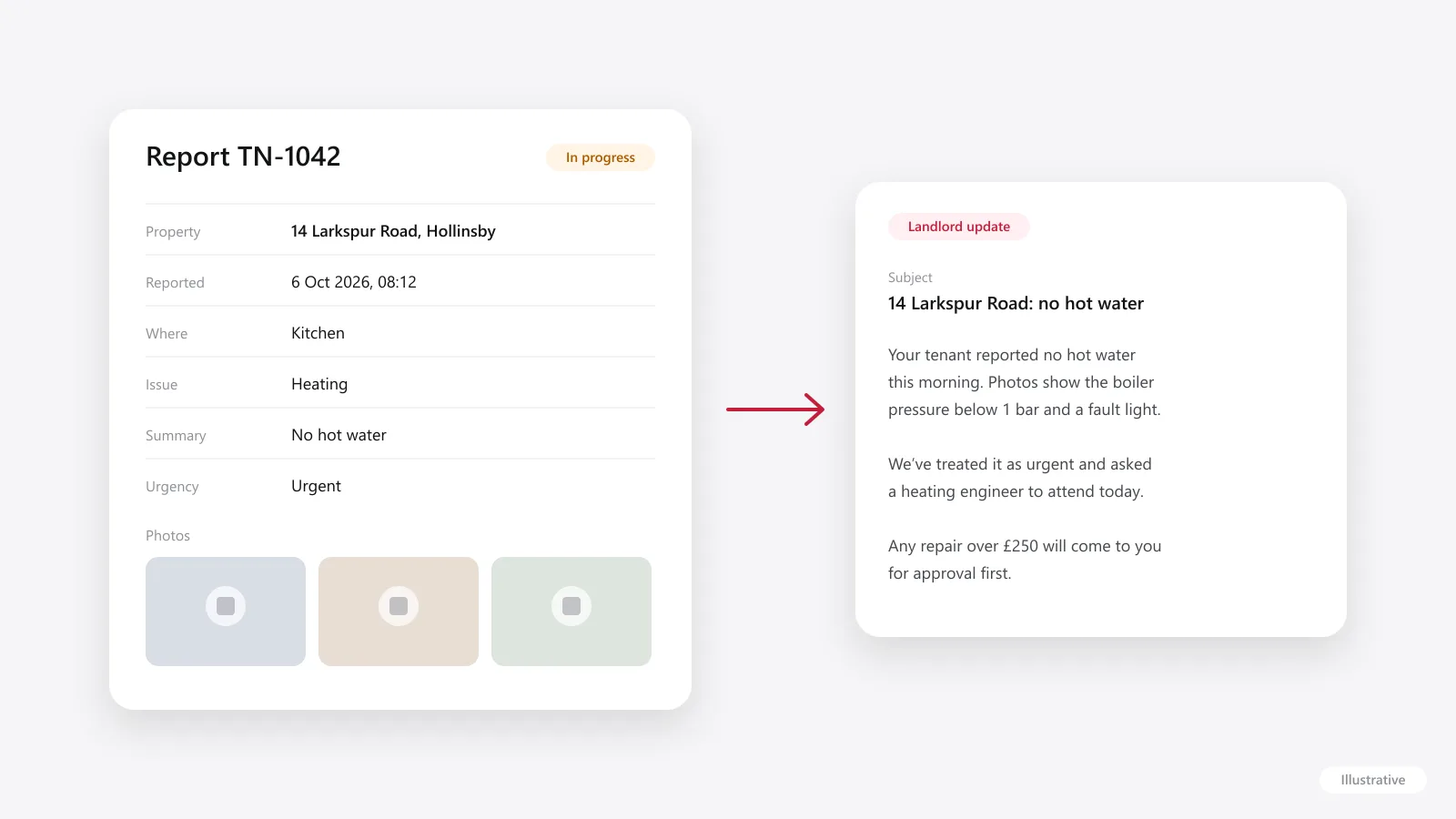
Here’s how the same repair looks when it arrives by WhatsApp, compared with a structured tenant report, and the landlord update you can write from it.
How it often arrives
“Hi, the boiler’s doing that thing again, no hot water since this morning. Can someone come? Will send pics later.”
How it arrives through Tenote
Property, location, issue type, description, urgency, photos and the tenant’s contact details, together in one report.
- Property
- 14 Larkspur Road, Hollinsby
- Reported
- 6 October 2026, 08:12
- Where
- Kitchen
- Issue
- Heating
- What’s happening
- No hot water
- More detail
- No hot water since this morning. The boiler pressure gauge is below 1 and showing a fault light.
- Urgency
- Urgent
- Photos
- 3 photos: boiler display, pressure gauge, pipework
- Status
- In progress
Subject: 14 Larkspur Road: no hot water (reported 6 October)
Your tenant reported this morning that there has been no hot water since early today. Their photos show the boiler pressure below 1 bar and a fault light.
We’ve treated it as urgent and asked Hollinsby Heating Co. to attend today. We’ll let you know what they find.
If the engineer recommends a repair over £250, we’ll send you the quote to approve before any work goes ahead.
Nothing in that update had to be chased or retyped. The facts came from the report; the agency added the decision and the next step.
Before you send a landlord update: a checklist
- The property address is in the subject line or first sentence.
- The problem is described in plain English, without contractor shorthand.
- It’s clear how urgent the repair is, and why.
- Photos or video are attached or described where they help.
- It says what has been done so far, and what happens next.
- Any decision the landlord needs to make is a clear question, with a cost if you have one.
- Facts (what was reported or found) are separate from opinions or estimates.
- Tenant personal details are limited to what the landlord actually needs.
- You’ve noted when you’ll update them again, or that this closes the repair.
Individual updates and periodic summaries
For a single repair, a short update at the points that matter is usually enough: when it’s reported, when a decision is needed, and when it’s resolved. Your management agreement may set out exactly when landlords should hear from you, so check it.
For landlords with several properties, a regular summary of what’s open and what’s been resolved can save a lot of individual emails. Because Tenote keeps each repair on the property’s record with its status, you can pull that together from one place rather than from inboxes.
What to leave out
- Internal notes and shorthand that only make sense to your team.
- Guesses about the cause or the cost before anyone has looked at it.
- More tenant personal information than the landlord needs. Data protection law expects you to share only what’s necessary.
- Long contractor notes copied in full. Summarise what was found and what it means.
What Tenote does, and doesn’t do, for landlord reporting
| Tenote does | Tenote doesn’t |
|---|---|
| Collect a structured report from the tenant, with photos or video | Send updates to landlords automatically |
| Keep each repair on the property’s record with its status | Give landlords a login or portal |
| Give you landlord-ready information from each report | Handle quotes, approvals or invoices |
| Let you forward the report to your own contractor | Track compliance, certificates or planned maintenance |
£89 a month, flat. No VAT to add. Unlimited properties and reports, and the first month is free. If tenants still report repairs by phone and WhatsApp, start with our tenant repair reporting page, or read about cutting maintenance admin more widely.
Questions
What should a landlord maintenance report include?
The property, the date reported, the issue in plain English, where in the property it is, how urgent it is, photos or video, the current status, what happens next, any decision the landlord needs to make, and how it was resolved.
How often should a letting agent update a landlord about repairs?
Usually at the points that matter: when a repair is reported, when the landlord needs to make a decision, and when it’s resolved. Check your management agreement, which may set specific expectations.
Does Tenote send reports to landlords?
No. Tenote gives your agency landlord-ready information from each report, and you decide what to send and when. Tenote doesn’t contact landlords for you.
Can landlords log in to Tenote?
No. Tenote is used by your agency and your tenants. Landlords hear from you, as they do now.
Do landlords see tenants’ contact details?
Only if you include them. You choose what goes into each landlord update, and you should share only what the landlord needs.
How much does Tenote cost?
£89 a month, flat, with no VAT to add. Unlimited properties and reports, and the first month is free.